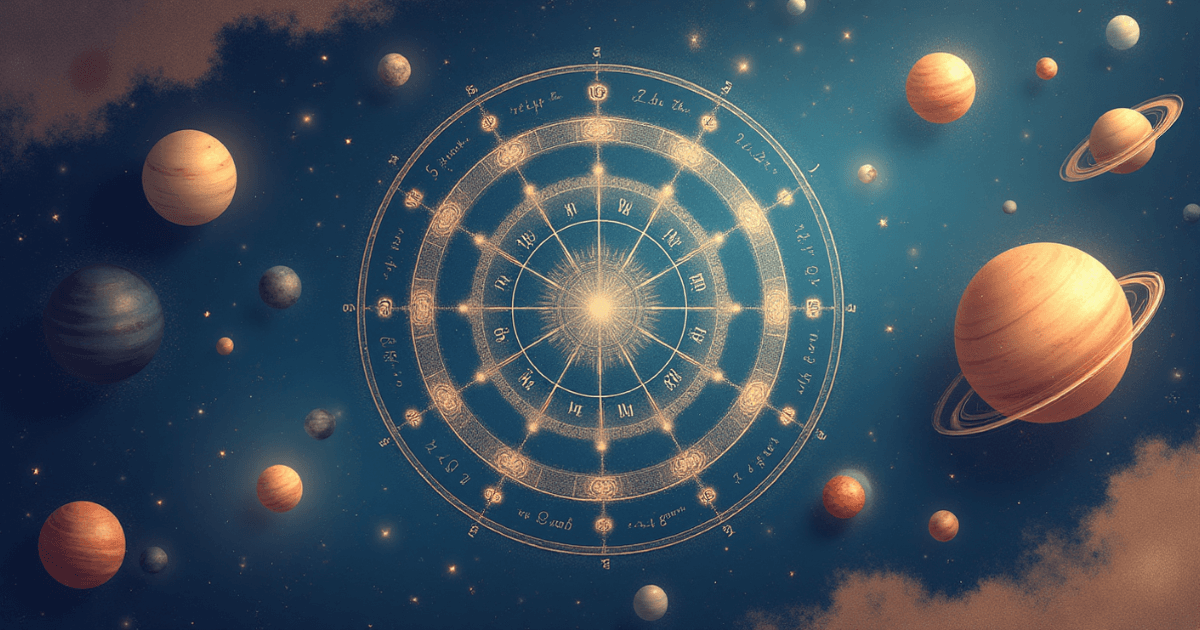
Your birth chart—also called a natal chart—is essentially a map of the sky at the exact moment you were born. It shows where the Sun, Moon, and planets were positioned, and how those positions relate to each other and to you.
Think of it as your cosmic fingerprint. No two birth charts are exactly alike, and yours reveals patterns about your personality, natural strengths, challenges you might face, and themes that may unfold throughout your life.
Here is how to understand yours.
What You Need to Calculate Your Birth Chart
To generate an accurate birth chart, you need three pieces of information:
1. Your birth date The day, month, and year you were born.
2. Your birth time As precise as possible. Even a difference of a few minutes can shift your Rising sign and house placements. If you do not know your exact time, check your birth certificate or ask family members. If it is truly unknown, you can still calculate a partial chart—you just will not have accurate Rising sign or house information.
3. Your birth location The city and country where you were born. This determines the exact positions of planets relative to the horizon and local sky.
With these three pieces of information, you can calculate your complete birth chart using the SpiriVerse Personal Space birth chart calculator or work with a professional astrologer for deeper interpretation.
The Big Three: Sun, Moon, and Rising
When someone asks "what's your sign?" they are asking about your Sun sign. But in astrology, three placements form the core of your personality—often called "The Big Three."
Your Sun Sign
What it represents: Your core identity, ego, and life purpose
How it manifests: The Sun sign describes who you are at your essence—your fundamental character, what drives you, and how you express your individuality. It is the part of you that remains consistent across different situations.
Example: A Leo Sun has an essential nature oriented toward creativity, self-expression, and leadership. Whether in their career, relationships, or hobbies, that Leo energy of wanting to shine and create will be present.
Your Moon Sign
What it represents: Your emotional nature, instincts, and inner world
How it manifests: While your Sun is who you are, your Moon is how you feel. It governs your emotional responses, what makes you feel secure, how you nurture yourself and others, and your instinctive reactions when you are not consciously thinking.
Example: Someone with a Cancer Moon feels emotions deeply, needs emotional security in relationships, and instinctively nurtures others. Their inner world is oriented toward family, home, and emotional connection—even if their Sun sign expresses very differently.
Your Rising Sign (Ascendant)
What it represents: Your outward persona, first impressions, and how you approach life
How it manifests: Your Rising sign is the zodiac sign that was rising on the eastern horizon at your birth moment. It shapes how you appear to others, especially in first meetings, and influences your physical appearance and personal style. It is also the lens through which you approach new situations.
Example: A Scorpio Rising comes across as intense, perceptive, and perhaps mysterious—even if their Sun and Moon are in lighter signs. People often guess their Rising sign rather than Sun sign based on first impressions.
Why All Three Matter
Your Big Three work together:
- Sun = Your core self and life direction
- Moon = Your emotional needs and inner life
- Rising = How you move through the world
Someone might be a Sagittarius Sun (adventurous, philosophical), Virgo Moon (needs order and practical expression of care), and Libra Rising (appears balanced, diplomatic, socially graceful). All three energies blend to create the full picture.
The Planets in Your Chart
Beyond the Big Three, every planet in our solar system appears somewhere in your birth chart, each representing a different aspect of life and personality.
Personal Planets (Move Quickly, Highly Individual)
Mercury — Communication, thinking style, learning How you process information, express ideas, and make decisions. Mercury shapes your intellectual approach and communication style.
Venus — Love, beauty, values, attraction What you find beautiful, how you express affection, what you value in relationships and life. Venus influences your aesthetic sense and romantic nature.
Mars — Action, drive, passion, conflict How you assert yourself, pursue goals, express anger, and take action. Mars is your energy and fighting spirit.
Social Planets (Move Slower, Generational Influence Modified by Personal Placement)
Jupiter — Expansion, luck, wisdom, opportunity Where you find growth, what comes easily, your philosophical outlook. Jupiter brings optimism and expansion wherever it falls in your chart.
Saturn — Structure, discipline, challenges, mastery Where you face lessons, must work harder, and ultimately build lasting achievement. Saturn asks for maturity and responsibility.
Outer Planets (Move Very Slowly, Generational)
Uranus — Innovation, rebellion, sudden change Generational shifts in how people approach freedom and individuality. Its house placement shows where you seek liberation.
Neptune — Dreams, spirituality, illusion, creativity Generational relationship with spirituality, imagination, and transcendence. Its placement shows where you seek the divine—or may be prone to confusion.
Pluto — Transformation, power, death and rebirth Generational approach to power and transformation. Where Pluto falls shows where you experience profound change and must confront shadow material.
The Twelve Houses
Your birth chart is divided into twelve sections called houses, each representing a different area of life. The planets in your chart fall into these houses, showing where their energies express most strongly.
1st House — Self, identity, physical body, first impressions 2nd House — Money, possessions, values, self-worth 3rd House — Communication, siblings, local travel, learning 4th House — Home, family, roots, emotional foundation 5th House — Creativity, romance, children, play 6th House — Health, daily work, service, routines 7th House — Partnerships, marriage, one-on-one relationships 8th House — Transformation, shared resources, intimacy, death 9th House — Higher education, travel, philosophy, meaning 10th House — Career, public image, authority, achievement 11th House — Friends, groups, hopes, social contribution 12th House — Spirituality, unconscious, hidden matters, endings
The sign on each house cusp (starting line) colors how you approach that life area. Planets in a house draw your attention and energy there.
Aspects: How Planets Talk to Each Other
Planets do not exist in isolation—they form relationships called aspects based on the angles between them. These aspects show how different parts of your personality interact.
Major Aspects
Conjunction (0°) — Planets blend their energies, intensifying both Opposition (180°) — Planets pull in opposite directions, creating tension that seeks balance Trine (120°) — Harmonious flow between planets, natural talents Square (90°) — Friction and challenge that drives growth Sextile (60°) — Gentle opportunity, requiring some effort to activate
Where Interpretation Gets Complex
This is where birth chart reading becomes an art, not just a science. A single aspect is easy to describe in isolation—but your chart has dozens of aspects all interacting simultaneously.
An experienced astrologer synthesizes these patterns, weighing which aspects dominate, how they modify each other, and what they mean for your specific life questions. A Moon-Saturn square means something different for someone asking about career versus someone navigating a difficult relationship with their mother.
This synthesis is where professional astrologers provide irreplaceable value. You can learn what each piece means individually, but weaving them into a coherent story about your life requires experience, intuition, and skill.
Reading Your Chart: Where to Start
With so much information, where do you begin?
Step 1: Know Your Big Three
Start with Sun, Moon, and Rising. These three placements give you the foundation. Read about each sign in these positions and notice how they blend in your experience.
Step 2: Find Your Chart Ruler
Your Rising sign has a ruling planet. That planet's placement is especially important—it is called your chart ruler.
For example: Scorpio Rising is ruled by Pluto (traditional: Mars). Where Pluto falls in your chart shows a key area of life focus and intensity.
Step 3: Notice Patterns
- Are many planets in one element? (Fire, Earth, Air, Water) This shows your dominant mode of operating.
- Are planets clustered in certain houses? Those life areas receive extra focus.
- What aspects are strongest? Tight aspects (exact or within 2-3 degrees) are most powerful.
Step 4: Go Deeper Over Time
A birth chart is not something you understand in one sitting. Return to it as you learn more astrology and as life unfolds. Patterns that seemed abstract often click when you experience their manifestation.
Transits: Your Chart in Motion
Your birth chart is static—it captures one moment in time. But the planets keep moving, and their current positions interact with your birth chart. This is called transits.
When Saturn transits (passes over) your natal Moon, for example, you might experience a period of emotional heaviness, necessary boundaries, or maturation in your feeling nature. When Jupiter crosses your natal Sun, opportunities and expansion related to your core identity often emerge.
You can track transits yourself to notice correlations between planetary movements and your life. But understanding how to work with a transit—what actions to take, what to avoid, how long a phase will last, and what it is preparing you for—is where an astrologer's guidance becomes invaluable.
What You Can Explore Alone vs. With an Astrologer
Understanding when to DIY and when to seek professional guidance helps you get the most from astrology.
Explore on Your Own
Learning the basics: Understanding what the signs, planets, and houses represent. This foundational knowledge makes any professional reading more meaningful.
Seeing your chart: Knowing your Big Three, where your planets fall, and what aspects you have. This is data—you can look it up and learn what each piece means individually.
Tracking transits: Noticing when significant planets cross important points in your chart and observing how those periods feel in your life.
General self-reflection: Reading about your placements and noticing what resonates. Astrology can be a powerful journaling and self-discovery tool.
Work With a Professional Astrologer
Synthesis and integration: An astrologer weaves dozens of chart factors into a coherent narrative about you. This is the difference between having puzzle pieces and seeing the complete picture.
Specific life questions: Asking about career direction, relationship compatibility, timing for major decisions, or understanding a challenging pattern in your life. Astrologers can focus interpretation on what matters to you right now.
Predictive guidance: Understanding what upcoming transits mean for you specifically, how long challenging periods will last, and how to work with the energy rather than against it.
Difficult chart patterns: Some configurations are complex or carry challenging energy. A skilled astrologer helps you understand these patterns constructively rather than fearing them.
Major life transitions: Starting a business, getting married, having children, changing careers, processing loss—these moments benefit from professional insight into timing and meaning.
Relationship astrology: Comparing charts (synastry) and understanding relationship dynamics requires expertise to interpret accurately.
Ongoing guidance: Many people work with an astrologer periodically—annually for a solar return reading, or during significant transits—as part of their personal growth practice.
Your Birth Chart Journey
Understanding your birth chart is a journey, not a destination. The more you learn, the more you see—and the more questions arise that benefit from professional guidance.
SpiriVerse Personal Space includes a free birth chart calculator that shows your Big Three, planetary placements, and current transits. Use it to explore your chart and build familiarity with your cosmic blueprint.
When you are ready for deeper insight—personalized interpretation, specific questions answered, or guidance through a challenging transit—connect with a professional astrologer on SpiriVerse who can help you understand what your chart means for your unique life path.
Ready to explore? Create your free Personal Space to see your birth chart, then browse astrologers on SpiriVerse when you are ready for personalized guidance.